Grimsby’s Victorian terraces and 1930s semis around Hainton Avenue and Freeman Street often received spray foam in the 2000s to cut heating costs. The region’s damp air from the Humber estuary and frequent winter rainfall mean many attics now suffer trapped condensation that rots rafters and soaks insulation. Removal requires cutting the foam in controlled sections rather than pulling it in sheets, because the material bonds tightly to the original lath and plaster ceilings below. Homeowners in DN32 postcodes frequently discover hidden water staining only after the first panels come down.
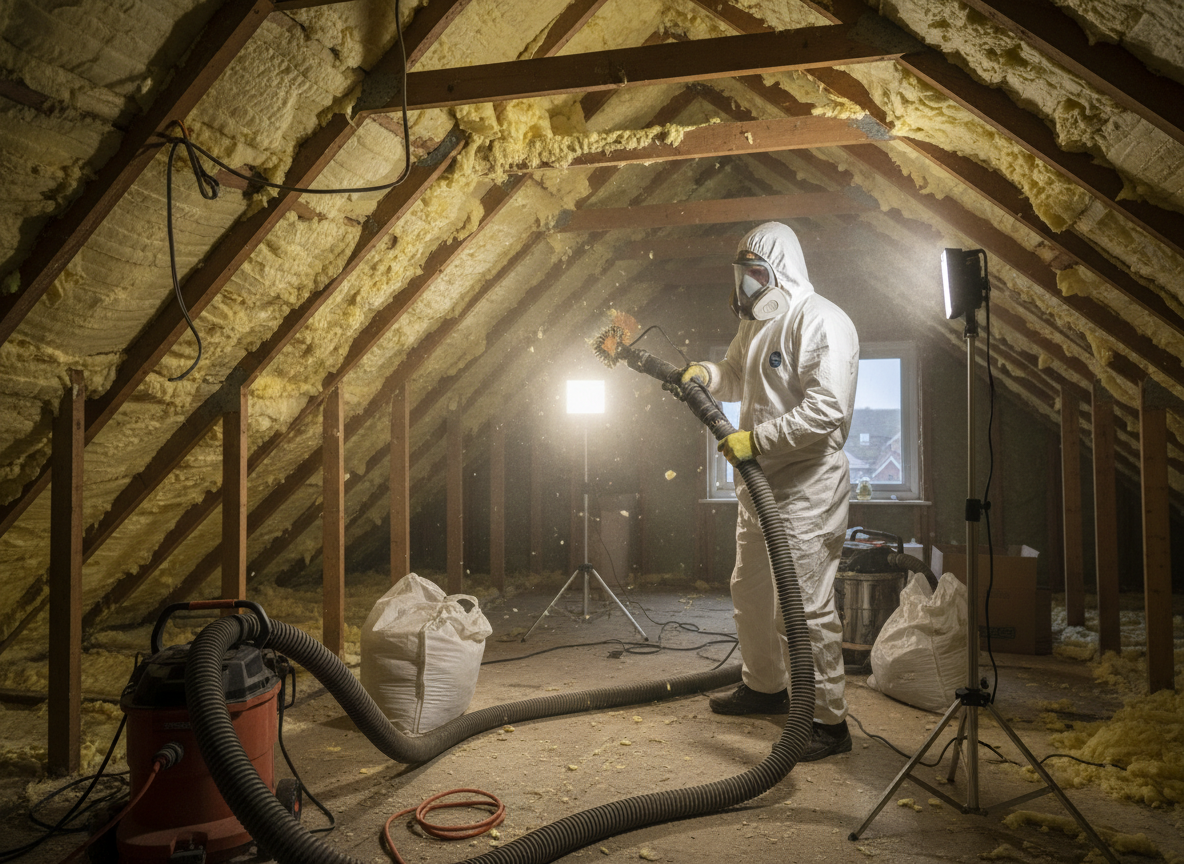
Mechanical removal with oscillating tools followed by hand scraping is standard here because the foam thickness varies from 75 mm on pitched roofs to 150 mm on flat sections common in Grimsby extensions. Dust extraction must run continuously; the fine particles travel easily through the narrow loft hatches found in terraced houses. After extraction, rafters are checked for rot and the original ventilation gaps are reopened so the roof can breathe again. Leaving any residue behind risks mould returning within one winter season.
Edge cases include foam applied over existing mineral wool in post-war bungalows near Cleethorpes Road, where the two materials have bonded and require separate passes. Electrical cables and old water tanks also sit close to the foam layer, so live circuits are isolated before work starts. Disposal follows local Lincolnshire waste rules for construction foam, with loads taken to the approved site rather than general landfill.
Technician insight
In Grimsby the thing that catches most people out with attic spray foam removal is how quickly moisture from the estuary creeps under the foam in pre-1950 brick terraces around Hainton Avenue; once you start cutting you often find the rafters already softening and the job expands before you can close the loft back up.
1930s semi near Freeman Street
Homeowner reported musty smells in the bedrooms below the loft. Inspection found closed-cell foam bonded directly to rafters with water pooling at the eaves. We cut and removed the foam in sections, reopened the original ventilation gaps and treated surface mould on the timber. Airflow was restored and the smell cleared within two weeks.
How it works
- 1
Initial Loft Inspection
Access the attic from inside the property, photograph existing foam depth and any visible moisture stains on rafters or ceiling boards.
- 2
Containment and Dust Control
Seal the loft hatch and run negative-air machines so particles do not enter living spaces below.
- 3
Sectional Foam Removal
Cut foam into manageable blocks with oscillating tools, then scrape residual material from timber without damaging original roof structure.
- 4
Debris Clearance and Ventilation Check
Bag and remove all waste, reopen eaves vents and ridge gaps, then confirm airflow before leaving site.
Pricing
Price depends on attic size, foam depth and access difficulty in Grimsby terraced and semi-detached homes.